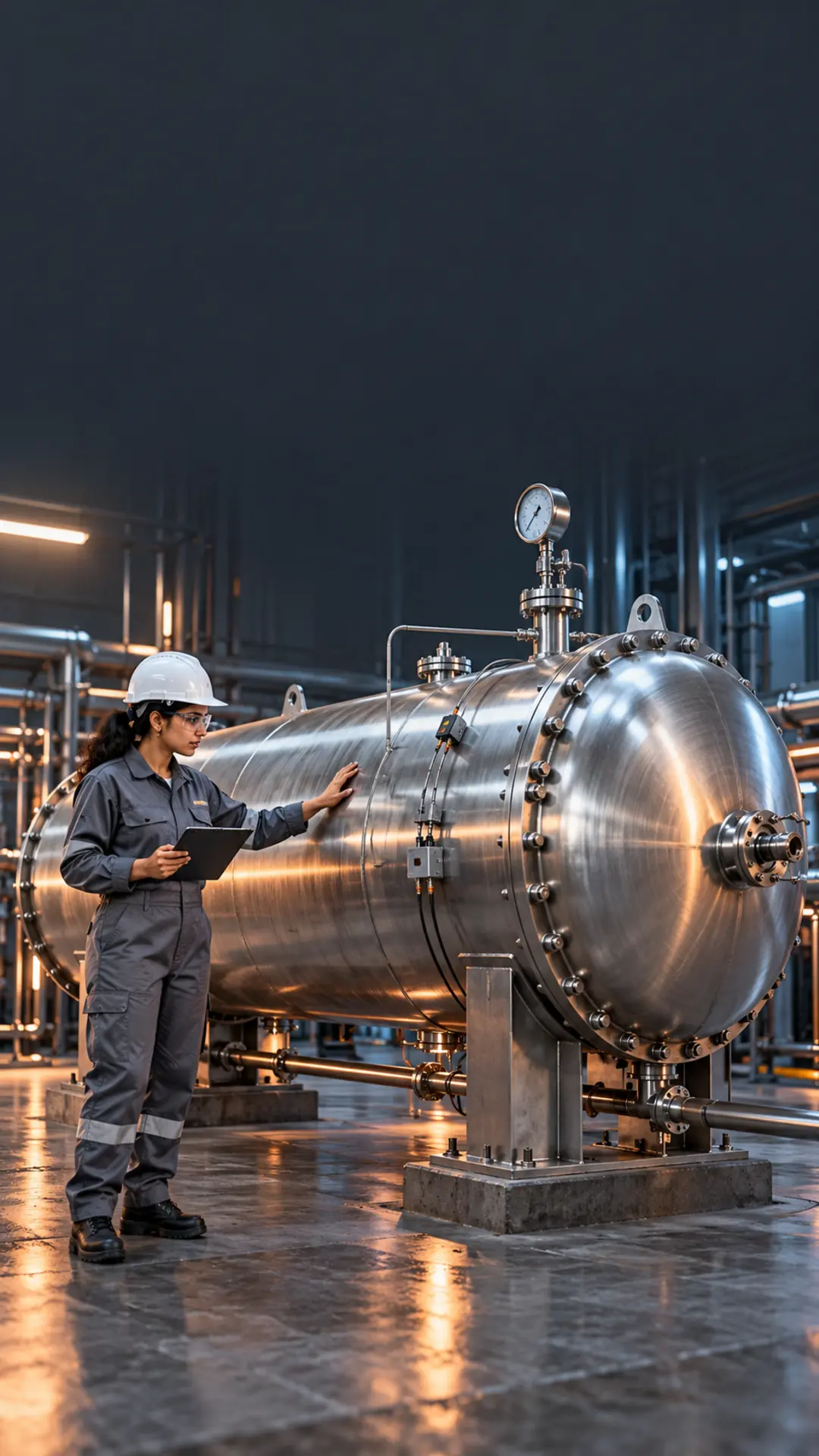
One Vessel. Two Membrane Stresses. Which One Governs?
A pressurized cylinder stretches around its circumference and along its axis. Those two directions do not carry equal stress.
1. Confirm the Geometry
The closed cylinder has a 1.0 m diameter and a 10 mm wall. The wall is small relative to the radius, supporting a thin-wall model.
2. Put Every Length in One Unit
Use D = 1000 mm and t = 10 mm with p = 2.0 MPa. Consistent units make the resulting membrane stress emerge in MPa.
3. Identify Hoop Stress
Hoop stress acts around the circumference. For a thin cylindrical wall, σh = pD/(2t).
4. Calculate 100 MPa Around the Wall
Substitution gives σh = (2.0 × 1000)/(2 × 10) = 100 MPa. This stress tends to split the cylinder lengthwise.
5. Calculate Longitudinal Stress
Axial force balance gives σL = pD/(4t). For the same vessel, the longitudinal stress is 50 MPa.
6. Compare Before Choosing
Hoop stress is exactly twice longitudinal stress in this ideal thin cylinder: 100 MPa versus 50 MPa.
7. Let Hoop Stress Govern
For the same allowable stress, hoop stress controls the basic wall-thickness check. Real designs must also assess joints, openings and local loads.
Check the Model. Balance the Forces. Compare Both.
Confirm thin-wall assumptions, keep units consistent, calculate both membrane stresses, and use the larger hoop stress for the basic check.
Solve the Full Vessel Case