1
Inspect
Review the problem, diagram, and evidence.
Can you diagnose the failure before the evidence gives it away?
Inspect, commit, prove, fix, and sign off.
Follow the investigation process used in the field — in five guided steps.
Review the problem, diagram, and evidence.
Choose your hypothesis.
Run calculations and test your idea.
Select and validate a safe correction.
See the full debrief and key takeaways.
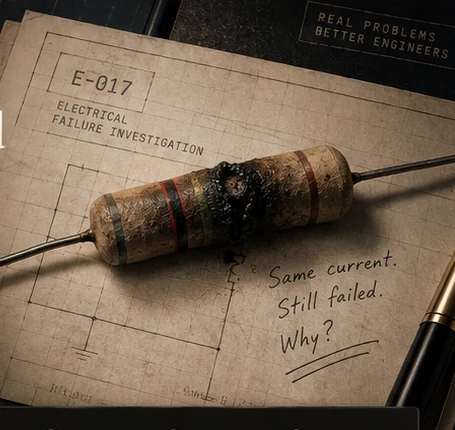
A 12 V source is connected across a required 2 Ω load. The calculated and measured current is 6 A, but the resistor overheats and fails within seconds. Identify the missing engineering check, prove the root cause, and choose a safe correction.
Find the root cause, confirm the fix, and see how this connects to the exam.
72 W operating dissipation exceeded the 10 W component rating.
A correct current calculation does not guarantee an adequately rated component.
Always compare calculated power with rated capacity and appropriate margin.
The resistor failed because its 10 W power rating was far below the 72 W it had to dissipate. Correct resistance and current values do not prove that a component is adequately rated.
Correct circuit behavior and safe component selection are separate checks. Calculate operating power and compare it with rated capacity plus design margin.
Because the resistor may be forced to dissipate more power than its wattage rating allows.
P = I²R = 6² × 2 = 72 W.
Check operating power against the component's rated power and apply an appropriate design margin.
Each case is designed to build the judgment, analysis, and confidence you need for engineering exams — and beyond.
Basic subject familiarity helps, but every case is designed to teach through the investigation itself.
Most cases are designed for a focused 5–10 minute investigation.
Each case is mapped to a verified exam, subject, topic, and misconception before publication.
The sealed debrief unlocks with the root cause, corrected reasoning, fix, and takeaway.