1
Inspect
Review the problem, diagram, and evidence.
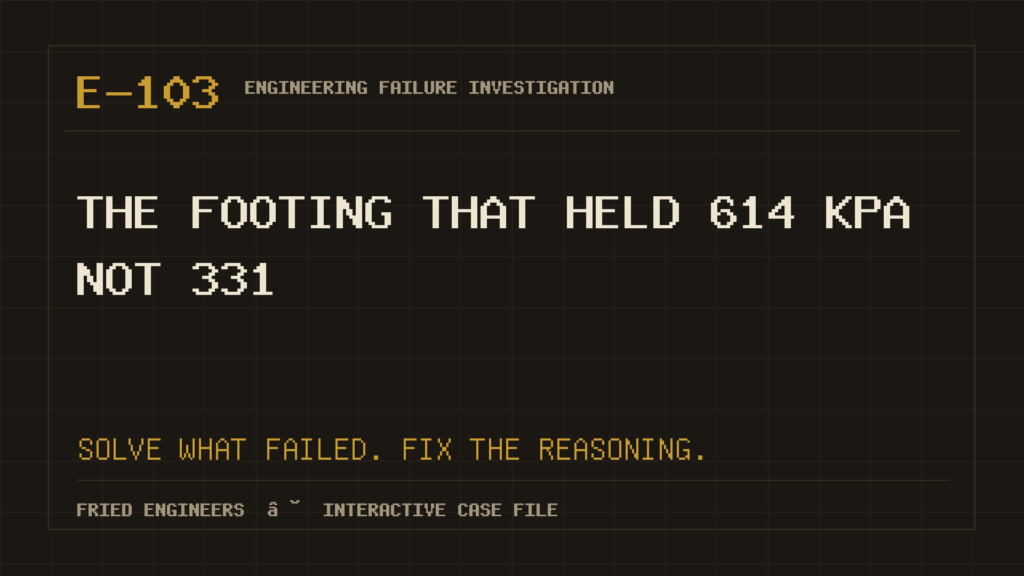
Using only the surcharge term gave 331 kPa. The width-dependent soil-weight term raised the gross ultimate bearing capacity to about 614 kPa.
Inspect, commit, prove, fix, and sign off.
Follow the investigation process used in the field — in five guided steps.
Review the problem, diagram, and evidence.
Choose your hypothesis.
Run calculations and test your idea.
Select and validate a safe correction.
See the full debrief and key takeaways.
A 2.0 m wide strip footing is embedded 1.0 m in cohesionless soil with unit weight gamma=18 kN/m³. Use Nq=18.4 and Ngamma=15.7 and the specified relation q_ult=gamma Df Nq+0.5 gamma B Ngamma. Determine gross ultimate bearing capacity and gross allowable pressure for FS=3.
Find the root cause, confirm the fix, and see how this connects to the exam.
The soil-weight bearing-capacity term was omitted.
Footing width contributes through 0.5 gamma B Ngamma.
Use the full stated bearing-capacity relation before applying factor of safety.
q_ult=18(1)(18.4)+0.5(18)(2)(15.7)=613.8 kPa. For FS=3, gross allowable pressure is 204.6 kPa.
For the formula specified in this case, q_ult=gamma Df Nq+0.5 gamma B Ngamma when c=0.
The surcharge term gamma Df Nq and the soil-weight term 0.5 gamma B Ngamma.
Each case is designed to build the judgment, analysis, and confidence you need for engineering exams — and beyond.
Basic subject familiarity helps, but every case is designed to teach through the investigation itself.
Most cases are designed for a focused 5–10 minute investigation.
Each case is mapped to a verified exam, subject, topic, and misconception before publication.
The sealed debrief unlocks with the root cause, corrected reasoning, fix, and takeaway.