1
Inspect
Review the problem, diagram, and evidence.
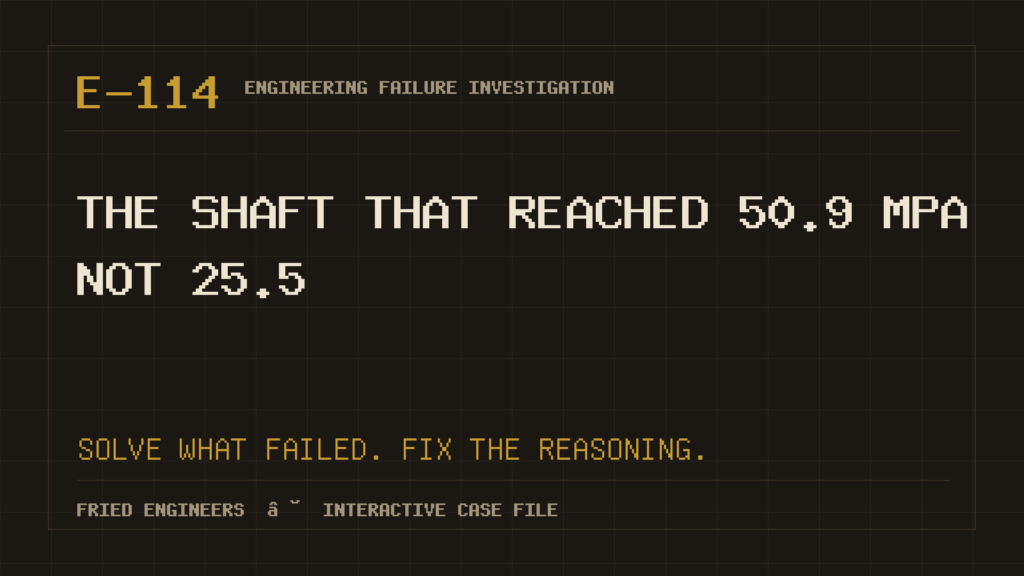
The polar moment was correct, but shear stress was evaluated at half the outer radius. Maximum torsional stress occurs at the outside surface and was 50.9 MPa.
Inspect, commit, prove, fix, and sign off.
Follow the investigation process used in the field — in five guided steps.
Review the problem, diagram, and evidence.
Choose your hypothesis.
Run calculations and test your idea.
Select and validate a safe correction.
See the full debrief and key takeaways.
A solid circular steel shaft has diameter d=50 mm and transmits torque T=1.25 kN·m. Determine maximum torsional shear stress. A note evaluates stress at r=12.5 mm instead of the 25 mm outer radius and reports about 25.5 MPa.
Find the root cause, confirm the fix, and see how this connects to the exam.
The stress was evaluated at an interior radius.
Torsional shear increases linearly from the center to the surface.
Use τmax=16T/(πd³) for a solid circular shaft.
τmax=16T/(πd³)=16(1.25×10^6)/(π50³)=50.93 MPa.
In a solid circular shaft, τ=Tr/J and the maximum occurs at the outer radius c=d/2.
At the outer surface.
Each case is designed to build the judgment, analysis, and confidence you need for engineering exams — and beyond.
Basic subject familiarity helps, but every case is designed to teach through the investigation itself.
Most cases are designed for a focused 5–10 minute investigation.
Each case is mapped to a verified exam, subject, topic, and misconception before publication.
The sealed debrief unlocks with the root cause, corrected reasoning, fix, and takeaway.