1
Inspect
Review the problem, diagram, and evidence.
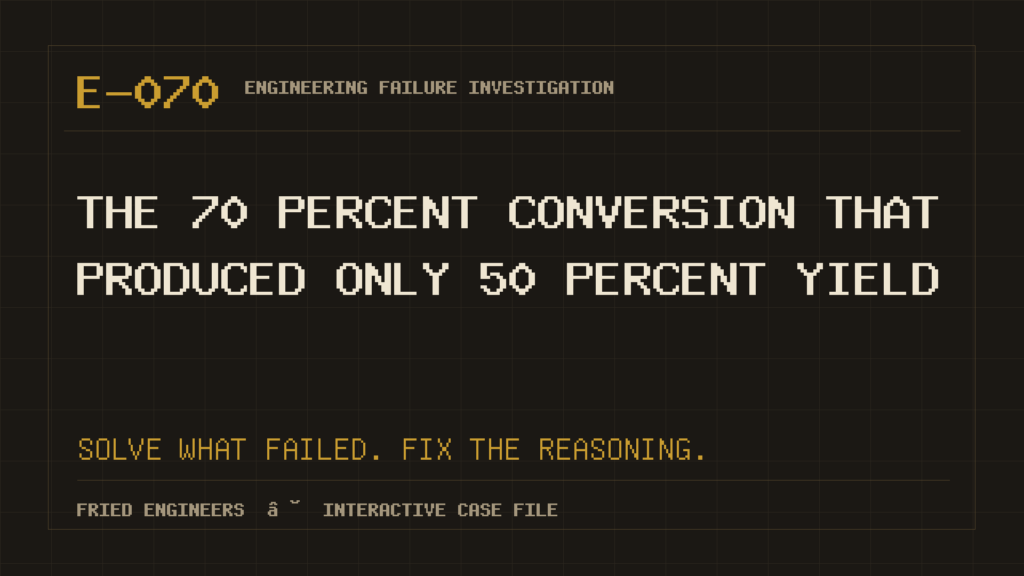
Seventy percent of A reacted, but only fifty percent of the feed became the desired product B. Conversion was not the same as yield.
Inspect, commit, prove, fix, and sign off.
Follow the investigation process used in the field — in five guided steps.
Review the problem, diagram, and evidence.
Choose your hypothesis.
Run calculations and test your idea.
Select and validate a safe correction.
See the full debrief and key takeaways.
Use a 100 mol A feed basis. Parallel reactions convert A one-for-one to desired product B or undesired product C. At the outlet, 30 mol A remains, 50 mol B has formed, and 20 mol C has formed. Define conversion as moles A reacted per mole A fed, desired-product yield as moles B formed per mole A fed, and selectivity as moles B formed per mole C formed. Calculate all three quantities.
Find the root cause, confirm the fix, and see how this connects to the exam.
Reactant conversion was reported as desired-product yield.
Twenty moles of A were consumed by the undesired parallel pathway.
Calculate conversion, yield, and selectivity from their stated bases separately.
On a 100 mol A feed basis, 30 mol A remaining means 70% conversion. If 50 mol B and 20 mol C form, the stated desired B yield is 50/100=50%, while B/C selectivity is 50/20=2.5.
Conversion tracks reactant consumption; yield and selectivity track how reacted material is distributed among products. Definitions must be stated explicitly.
No. Conversion measures how much reactant is consumed; yield measures desired product according to a stated basis.
2.5 mol B per mol C.
Each case is designed to build the judgment, analysis, and confidence you need for engineering exams — and beyond.
Basic subject familiarity helps, but every case is designed to teach through the investigation itself.
Most cases are designed for a focused 5–10 minute investigation.
Each case is mapped to a verified exam, subject, topic, and misconception before publication.
The sealed debrief unlocks with the root cause, corrected reasoning, fix, and takeaway.