1
Inspect
Review the problem, diagram, and evidence.
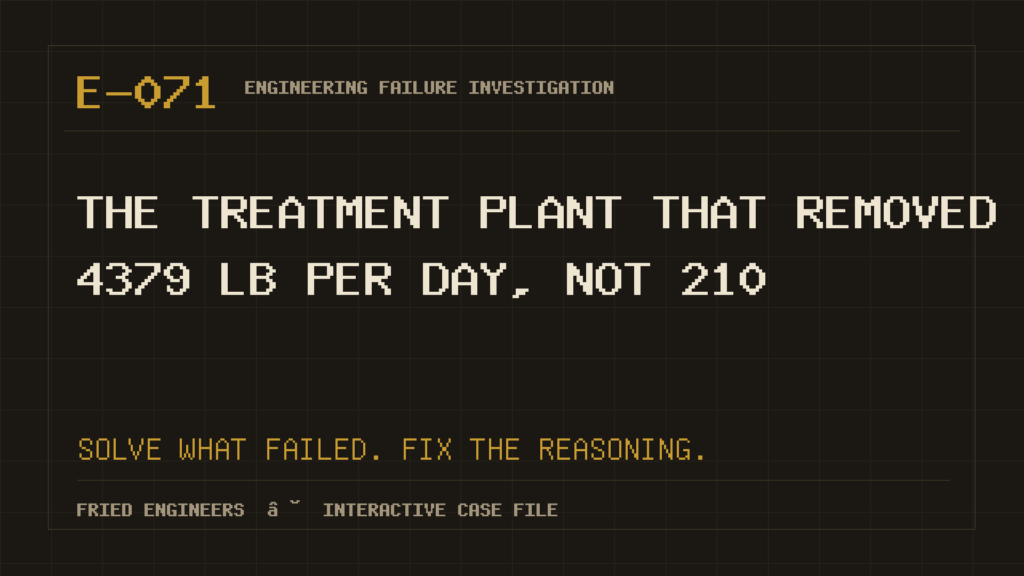
The concentration drop was 210 mg/L, but that was not a mass removal rate. At 2.5 MGD, the plant removed about 4,379 lb/day of BOD.
Inspect, commit, prove, fix, and sign off.
Follow the investigation process used in the field — in five guided steps.
Review the problem, diagram, and evidence.
Choose your hypothesis.
Run calculations and test your idea.
Select and validate a safe correction.
See the full debrief and key takeaways.
A wastewater plant treats 2.5 MGD. Influent BOD is 240 mg/L and effluent BOD is 30 mg/L. Assume the same flow rate at the inlet and outlet and use 8.34 as the lb/day conversion factor for MGD·mg/L. A note reports 210 lb/day removed because 240-30=210. Determine the influent load, effluent load, mass removed per day, and percent removal.
Find the root cause, confirm the fix, and see how this connects to the exam.
A concentration difference was labeled as a mass removal rate.
Volumetric flow and unit conversion.
Use Q×C×8.34 for lb/day loading when Q is in MGD and C is in mg/L.
Using load=Q(MGD)×C(mg/L)×8.34, the influent BOD load is 5004 lb/day and the effluent load is 625.5 lb/day. The plant removes 4378.5 lb/day, and the removal efficiency is 87.5%.
Mass loading depends on both concentration and volumetric flow. Removal efficiency is based on the ratio of removed concentration or load to the influent value when flow is unchanged.
For Q in MGD and C in mg/L, use load=Q×C×8.34.
87.5% when inlet and outlet flow are the same.
Each case is designed to build the judgment, analysis, and confidence you need for engineering exams — and beyond.
Basic subject familiarity helps, but every case is designed to teach through the investigation itself.
Most cases are designed for a focused 5–10 minute investigation.
Each case is mapped to a verified exam, subject, topic, and misconception before publication.
The sealed debrief unlocks with the root cause, corrected reasoning, fix, and takeaway.